Hands-On Surgical Training: How General Dentists Build Real Confidence in the Operatory
Clinical Education
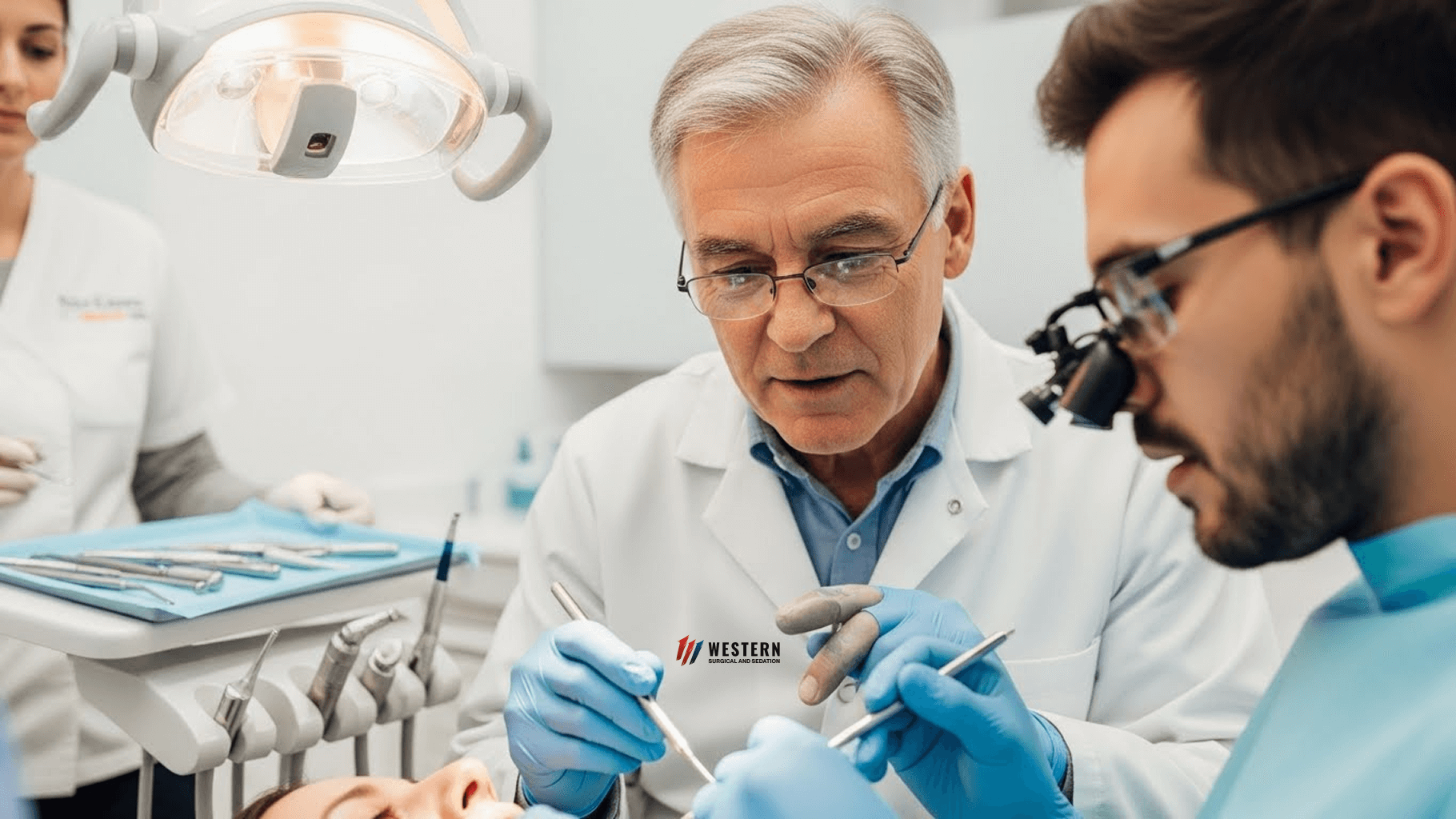
Most general dentists were never taught to extract third molars in dental school. The curriculum covers the basics — and refers the rest. But for dentists who want to grow their scope of practice and stop sending patients elsewhere, that gap is exactly where hands-on surgical training begins.
At Western Surgical and Sedation, we train general dentists to perform wisdom teeth extractions and IV moderate sedation in their own offices — through live patient training, one-on-one mentorship, and structured continuing education designed for real clinical environments.
Why Confidence in the Operatory Can't Come from a Textbook
Surgery is a skill. And like any skill, it requires repetition under pressure, not just comprehension. A dentist can read every chapter on third molar anatomy and still freeze when a root fractures unexpectedly mid-extraction.
Hands-on dental surgical training exists to close that gap — not by eliminating uncertainty, but by training dentists to respond to it calmly and correctly.
What Lectures and Simulations Can't Teach
Simulation labs are valuable for building baseline familiarity. But they compress anatomy, eliminate variability, and remove the psychological weight of an actual patient in the chair. Live training doesn't.
When you train with real patients — as you do at Western Surgical and Sedation — you encounter:
Anatomical variation that no textbook fully prepares you for
Bleeding patterns that require real-time adaptation
Patient anxiety that tests your communication as much as your technique
Decision-making under pressure that simulation simply cannot replicate
These are the moments where surgical confidence is either built or avoided.
The Clinical Skills General Dentists Develop Through Hands-On Training
Hands-on surgical CE courses for dentists aren't just about technique — they're about building a complete clinical framework. When you leave a well-structured surgical training program, you should be able to:
1. Assess Case Difficulty Before You Begin
Experienced surgeons assess risk before they pick up an instrument. Training teaches you to read a panoramic radiograph, identify proximity to the inferior alveolar nerve, and classify third molars using established difficulty indices — so you select appropriate cases for your skill level from day one.
2. Execute Soft Tissue and Bone Management
Flap design, sectioning technique, and bone removal are learned by doing. Each case sharpens your ability to work efficiently, minimize trauma, and reduce post-operative complications for your patients.
3. Manage Complications Without Panic
Broken roots, excessive bleeding, dry socket prevention — complications are not failures. They're expected variables. Hands-on training teaches you to recognize, manage, and document them with the same calm you'd want your patients to see.
4. Integrate IV Sedation into Your Surgical Cases
For many general dentists, offering IV moderate sedation alongside wisdom teeth extractions is what makes the procedure viable in-office. Patients who would otherwise refuse surgery under local anesthetic alone will say yes to sedation. Training in both — simultaneously — is what allows dentists to build a complete, profitable surgical service line.
From CE Credit to Revenue: The Practice Impact of Surgical Training
Adding wisdom teeth extractions to a general dental practice isn't just a clinical decision — it's a financial one. The average third molar extraction generates between $300 and $700 per tooth, with surgical cases at the higher end. A dentist performing four surgical extractions per week adds meaningful annual revenue that previously left the practice through referrals.
Beyond revenue, in-office surgical capability increases patient retention. When a patient doesn't need to be sent to an oral surgeon, they stay in your practice — and they refer others.
Western Surgical and Sedation's training programs are designed with this reality in mind. We don't just teach technique; we help dentists build the clinical workflow to integrate surgery into their existing schedule.
What Makes Western Surgical and Sedation Different
There are several CE programs that offer surgical training for dentists. Most rely heavily on didactic content and limited hands-on time. Western Surgical and Sedation was built around a different model:
Live patient training — not mannequins, not simulations
One-on-one mentorship — direct guidance from experienced oral surgeons
Continuum of courses — structured progression from foundational to advanced cases
Online + in-person formats — flexible CE that fits a working dentist's schedule
Nationally approved PACE provider — CE credits accepted for FAGD/MAGD
The goal isn't to produce dentists who've sat through a course. It's to produce dentists who can operate with confidence on Monday morning.
Frequently Asked Questions
Is hands-on surgical training appropriate for a dentist with no extraction experience?
Yes. Our foundational courses are designed for general dentists at all experience levels. We start with case selection, patient evaluation, and basic extraction technique before progressing to surgical cases.
How many live patient cases will I complete during training?
This depends on the specific course. Our programs are structured to maximize hands-on time with real patients under direct mentorship — not to limit it. Contact us to discuss the format that fits your current skill level.
Can I integrate IV sedation training into the same program?
Yes. Western Surgical and Sedation offers training in both wisdom teeth extraction and IV moderate sedation. Combining both allows you to offer a complete in-office surgical experience to your patients.
Will this training qualify for CE credit?
Yes. Western Surgical and Sedation is a nationally approved PACE Program Provider for FAGD/MAGD credit (Provider ID #342389, approved through 2/28/2027).
Related Articles
Related reading
Explore articles connected to surgical training, IV moderate sedation, and real world clinical decision making, selected to support dentists applying advanced care in daily practice.


