How General Dentists Can Add Wisdom Teeth Extractions to Their Practice
Clinical Education
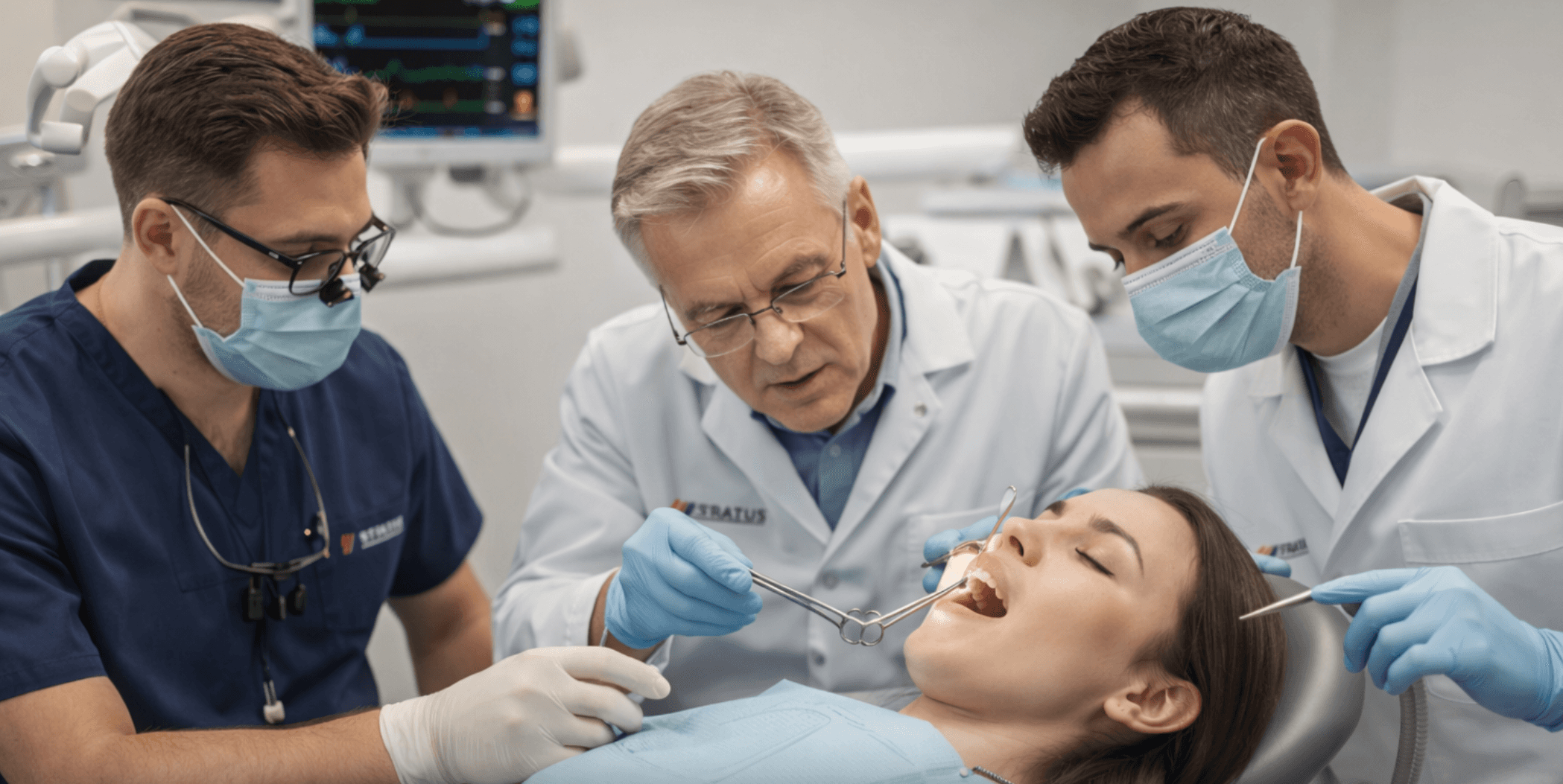
Most general dentists refer out wisdom teeth extractions every week. The math adds up quickly: four cases at $600 each, referred out, is $2,400 leaving your practice before Monday ends. Multiply that across a year, and you are looking at well over $100,000 in revenue that could have stayed in-house.
The common assumption is that third molar extractions belong to oral surgeons. That assumption is costing general dentists a significant portion of the revenue they have already earned by diagnosing and treating the patient up to that point.
Adding wisdom teeth extractions to your practice is not a reckless move. It is a deliberate, structured clinical expansion that thousands of general dentists have made successfully — when they have the right training behind them.
This article walks through exactly how that process works: what you need to learn, how to select appropriate cases, how training translates to the operatory, and what the realistic revenue impact looks like.
Why General Dentists Are Qualified to Extract Wisdom Teeth
The question of whether general dentists should extract third molars is less a question of scope and more a question of training. General dentists perform extractions routinely. Simple and moderately impacted third molars fall within the clinical skill set of a well-trained general dentist — the gap is not in ability, but in preparation.
Dental school provides foundational extraction experience, but it rarely includes enough exposure to impacted third molars for a graduate to feel clinically confident on day one. The cases are complex enough and the consequences of poor technique significant enough that most dentists default to referral rather than risk patient harm.
That default makes sense without training. With structured, hands-on training in real clinical environments, that calculus changes completely.
The dentists who consistently perform third molar extractions in their own practices are not unusually gifted surgeons. They received focused training, developed a repeatable workflow, and built case selection criteria that kept them operating within their competency.
Western Surgical and Sedation trains general dentists specifically to close this gap — not through lectures or simulation labs, but through live patient training with direct faculty guidance.
Step 1: Understand What Cases Belong in Your Practice
Not every wisdom tooth is appropriate for a general dentist to extract, and knowing the difference is the first clinical skill you need to develop. Case selection is not a limitation — it is what makes in-house surgical care safe and sustainable.
Third molars are classified by their degree of impaction and anatomical position. The most widely used system evaluates factors such as angulation, depth below the occlusal plane, relationship to the inferior alveolar nerve, and available space. Learning to read a panoramic radiograph accurately and assign a difficulty rating is the foundation of safe case selection.
Cases appropriate for general dentists with surgical training:
Soft tissue impactions with clear eruption path
Partial bony impactions with favorable angulation
Full bony impactions with adequate space and normal anatomy
Cases where nerve proximity is not a limiting factor
Cases that should continue to be referred:
Deeply impacted teeth with direct inferior alveolar nerve contact
Patients with significant medical comorbidities requiring hospital-based care
Complex anatomy that exceeds your current skill level — and that threshold shifts as experience builds
A well-structured training program teaches you to make this assessment consistently and confidently before you pick up an instrument.
Step 2: Get the Right Training — What to Look For
Not all continuing education in oral surgery is equal. A weekend lecture course with a handful of typodont exercises does not translate into clinical confidence. The training that actually moves the needle is built around live patient experience with real-time guidance from an instructor who performs these procedures in daily practice.
When evaluating surgical training programs for third molar extractions, look for:
Live patient training — not simulation only
Direct faculty guidance during each case, not just observation
A structured curriculum that progresses from case selection through post-operative care
Continuing education credit aligned with your state board requirements
Post-course mentorship to support implementation in your own practice
The Impact7 Techniques Course at Western Surgical and Sedation is built on exactly this framework. Participants complete 8 to 10 live patient extractions over two intensive days at our Murray, Utah clinic or in Oklahoma City, Oklahoma. Every case is performed under direct faculty supervision, with real-time feedback on flap design, bone removal, sectioning technique, and complication management.
The course is intentionally limited to ten dentists per session to preserve the mentorship ratio that makes hands-on learning effective.
Dentists who complete the Impact7 Techniques Course leave with documented live patient experience, a structured surgical workflow, and the case selection framework they need to begin implementing third molar extractions in their own practices immediately.
Step 3: Build a Surgical Workflow Before You Start
Returning from training and immediately scheduling surgical cases without a defined workflow is a mistake. The clinical confidence you built in training needs to be supported by a practice infrastructure that is ready to handle surgical patients safely and efficiently.
Before your first post-training case, establish the following:
Patient screening protocol
Define the criteria a patient must meet to be considered for in-house extraction rather than referral. Document this protocol so it is applied consistently by every member of your team involved in treatment planning.
Radiographic evaluation standard
Determine which imaging you require before accepting a surgical case, and who performs the initial difficulty assessment. If you use a difficulty index, adopt one consistently and train your team on the language.
Surgical instrumentation
Identify the instruments and materials you need for the cases you plan to accept. Start with the core kit — periotomes, elevators, surgical handpiece, suture material — and expand as your case complexity grows.
Post-operative care protocol
Develop a written post-operative instruction sheet specific to third molar extractions. Define your protocol for follow-up calls, dry socket management, and the threshold for referring a complication you are not comfortable managing in-house.
Scheduling structure
Decide how you will schedule surgical cases within your existing appointment flow. Most dentists begin by blocking one surgical morning per week, then expand based on demand and comfort.
Having this infrastructure in place before your first case reduces decision fatigue and keeps your focus where it belongs — on the patient in the chair.
Step 4: Add IV Sedation to Make Cases More Accessible
Wisdom teeth extractions performed under local anesthetic alone are clinically viable, but patient acceptance is lower. Many patients who need third molars removed have significant anxiety about oral surgery, and a recommendation for local-only extraction is frequently the reason a case does not move forward.
Offering IV moderate sedation alongside wisdom teeth extractions changes this dynamic. Patients who would decline surgery under local alone will accept it when sedation is available. Sedation is not just a comfort option — it is a case acceptance driver.
The Sedation6 program at Western Surgical and Sedation is an 80-hour, ADA-aligned IV moderate sedation training program that includes 20 or more live patient sedation cases. It is designed specifically for general dentists who want to offer sedation safely and responsibly in their own practices.
Training in both surgical extraction and IV sedation simultaneously is what allows a general dentist to build a complete, in-house third molar service — the kind that generates consistent revenue without depending on a referral relationship.
The Revenue Impact: What the Numbers Actually Look Like
The financial case for adding wisdom teeth extractions is straightforward, but it is worth being specific rather than vague.
The average fee for a single third molar extraction with IV sedation in the United States ranges from $500 to $900 per tooth, depending on complexity and geography. A patient presenting with all four third molars requiring extraction represents $2,000 to $3,600 in a single appointment — revenue that currently leaves your practice entirely when you refer.
A general dentist performing two surgical extraction appointments per week at an average of $1,800 per appointment generates approximately $172,800 in additional annual production. That figure accounts for roughly 48 working weeks and does not include the additional production from sedation fees or the downstream value of retaining patients who would otherwise establish care with the oral surgeon they were referred to.
Dentists who complete the Impact7 Techniques Course and integrate surgical extractions into their practice consistently report adding two to three new surgical cases per week within 90 days of completing training.
The return on the training investment is not measured in years. For most dentists, the cost of the program is recovered within the first two to three months of implementation.
Frequently Asked Questions
Is it legal for a general dentist to extract wisdom teeth?
Yes. Wisdom tooth extractions are within the scope of practice for licensed general dentists in all 50 states. The specific regulations around IV sedation vary by state — Western Surgical and Sedation provides licensing and permit guidance as part of the Sedation6 program.
How long does it take before I can start doing cases?
Dentists who complete the Impact7 Techniques Course are prepared to begin case selection and scheduling immediately. Most begin their first in-house surgical cases within 30 to 60 days of completing training, once their practice infrastructure is in place.
What if I encounter a complication I cannot manage?
Complication recognition and management is a core component of the training curriculum. You will learn to identify, manage, and document the complications most likely to occur in the case types you select. Post-course mentorship through Western Surgical and Sedation provides ongoing access to faculty guidance when you encounter situations you want a second opinion on.
Do I need a separate operatory for surgical cases?
Not necessarily. Many general dentists begin performing wisdom tooth extractions in their existing operatory with minor equipment additions. A surgical handpiece, adequate suction, and appropriate lighting are the primary infrastructure requirements. Your trainer can advise on operatory setup during or after training.

Related Articles
Related reading
Explore articles connected to surgical training, IV moderate sedation, and real world clinical decision making, selected to support dentists applying advanced care in daily practice.


