

What to Expect During IV Sedation Training: A Day-by-Day Guide
What to Expect During IV Sedation Training: A Day-by-Day Guide
URL Slug: `what-to-expect-iv-sedation-training-course-experience`
Canonical URL: `https://westernsurgicalandsedation.com/post/what-to-expect-iv-sedation-training-course-experience`
Post Description (Meta): Wondering what IV sedation training is really like? This day-by-day guide walks you through the full course experience from didactic to live patient sedation. (162 characters)
SEO Meta Title: What to Expect During IV Sedation Training: Day-by-Day Guide | Western Surgical
Primary Keyword: iv sedation training course experience
Secondary Keywords: what happens during sedation training, iv sedation course curriculum, dental sedation training program, sedation certification course details
Category: IV Sedation Training
Publish Date: February 2026 (Week 4)
---
Considering IV Sedation Training? Here's Exactly What Happens When You Walk Through the Door
You've researched the benefits. You've run the revenue numbers. You've read the articles about how sedation transforms dental practices. But there's one question that articles about ROI and practice growth don't usually answer: What is the training actually like?
It's a fair question — and an important one. You're about to invest significant time, money, and professional commitment into developing a new clinical skill. Understanding exactly what that experience looks like, day by day, removes the uncertainty and helps you arrive prepared to get maximum value from every hour of training.
This guide walks you through what a comprehensive IV sedation training program looks like from start to finish — the didactic foundation, the hands-on clinical experience, and everything that happens between your first lecture and your last live patient case.
Western Surgical and Sedation's IV moderate sedation training program is built on 60,000+ real sedation cases. Our 2:1 student-to-instructor ratio ensures you get personal attention and real clinical reps — not just observation. This guide reflects the structure and intensity of our actual training experience.
---
Table of Contents
---
Before You Arrive: Pre-Course Preparation
Your training starts before you arrive at the facility. Quality programs provide pre-course materials designed to build a knowledge foundation so that classroom time focuses on application and clinical judgment rather than basic terminology.
Pre-Reading and Study Materials
Expect to receive pharmacology fundamentals covering the sedation agents you'll be using — mechanism of action, onset and duration, dosing ranges, and side effect profiles. You'll study patient assessment protocols including ASA classification, airway assessment, and medical history review. Monitoring technology overviews covering pulse oximetry, capnography, blood pressure monitoring, and ECG will be included. And state regulatory frameworks providing a general overview of permit requirements and scope of practice for moderate sedation will round out the pre-reading.
Investing serious time in these pre-course materials pays off significantly. Students who arrive with a solid foundation in the fundamentals get far more from the clinical portions of training because they can focus on skill development and clinical decision-making rather than trying to absorb basic science content on the fly.
What to Bring
Beyond the obvious professional items (your dental license documentation, any prerequisite certifications), plan to bring comfortable clothing suitable for clinical settings, a notebook for personal notes (separate from course materials), and any specific questions about your practice setup, state permit requirements, or patient populations you anticipate serving. Instructors welcome specific questions and can provide targeted guidance when they know your individual situation.
---
The Didactic Foundation
The classroom component of sedation training covers the medical and scientific knowledge that underpins safe sedation practice. This isn't a passive lecture experience — quality programs emphasize interactive learning, case discussions, and clinical reasoning.
Pharmacology Deep Dive
You'll go well beyond the pre-course introduction to sedation pharmacology. Expect detailed coverage of benzodiazepines — particularly midazolam, its pharmacokinetics, dose-response relationships, and the clinical nuances of titration to effect. You'll learn about supplemental agents (analgesics, antiemetics, reversal agents) and how they integrate into your sedation protocol.
The goal isn't memorizing drug tables — it's developing the pharmacological understanding to make real-time clinical decisions. When a patient isn't responding as expected to your standard titration, pharmacological knowledge is what guides your next move.
Patient Assessment and Selection
This module translates the screening concepts from the pre-course materials into practical clinical decision-making. You'll work through case scenarios with real patient profiles — reviewing medical histories, interpreting assessment findings, and making go/modify/defer/refer decisions.
This is where the classroom starts to feel like practice. Instructors present complex patient cases and guide you through the clinical reasoning process, challenging assumptions and building the judgment you'll rely on in your own office.
Monitoring and Interpretation
Understanding what your monitors display is different from understanding what those readings mean clinically. This module covers reading and interpreting pulse oximetry trends (not just single readings), capnography waveform analysis — what normal looks like, what early respiratory depression looks like, and what airway obstruction looks like, blood pressure and heart rate changes during sedation and what they indicate, and ECG rhythm recognition for the most clinically relevant arrhythmias.
You'll practice interpreting real monitoring data from actual sedation cases, building pattern recognition that translates directly to clinical vigilance during your own cases.
Airway Management Principles
Since airway compromise is the most critical potential complication of sedation, airway management receives significant attention. The didactic component covers airway anatomy and the factors that affect airway patency during sedation, recognition of airway obstruction and respiratory depression, and the management algorithm — from simple maneuvers (chin lift, jaw thrust) through advanced airway devices.
This classroom foundation prepares you for the hands-on airway management practice that follows.
---
Hands-On Clinical Skills Labs
The transition from classroom to clinical skills lab is where training gets tangible. You're putting your hands on equipment, practicing techniques, and building the muscle memory that clinical confidence requires.
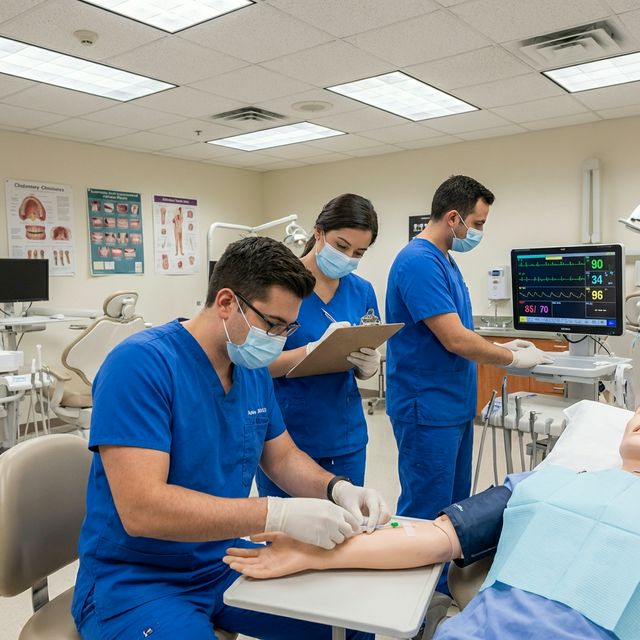
Venipuncture and IV Access
If you don't already have IV access skills, you'll develop them here. Practice sessions cover vein selection and assessment, tourniquet application and technique, catheter insertion mechanics, IV line securing and maintenance, and troubleshooting common issues (infiltration, occlusion, difficult access).
For dentists who've never started an IV line, this can feel intimidating initially. Within a few practice sessions, most students develop comfortable competency. The key is repetition — and quality programs provide enough practice time that you leave confident in your IV skills.
Monitoring Equipment Setup and Operation
You'll work hands-on with the same types of monitoring equipment you'll use in your practice — setting up multiparameter monitors, applying sensors, calibrating devices, and practicing the workflow of patient monitoring from setup through sedation through recovery.
Understanding your equipment operationally — not just theoretically — means you're not fumbling with unfamiliar devices during your first real sedation case. You should be able to set up monitoring, recognize normal versus abnormal readings, and troubleshoot common equipment issues without hesitation.
Drug Preparation and Administration
Precise drug preparation is a safety-critical skill. Lab sessions cover drawing medications from vials (proper technique for single-dose and multi-dose vials), calculating dosages based on patient weight and condition, preparing syringes with correct volumes, proper labeling and handling protocols, and titration technique — the art of administering small increments and observing response before giving more.
Titration is arguably the most important clinical skill in sedation. It's what makes IV sedation safer than oral sedation and what gives you the real-time control that protects patients. You'll practice titration technique extensively before doing it with live patients.
Airway Management Hands-On
Using mannequins and simulation equipment, you'll practice bag-valve-mask ventilation technique, oral and nasal airway insertion, suction technique for airway management, and head positioning and jaw manipulation maneuvers.
The goal is to make these skills reflexive. In the rare event that a patient needs airway support during sedation, you need to act immediately and correctly without having to think through the mechanics.
---
Live Patient Clinical Sessions
This is the heart of the training — performing sedation on real patients under direct expert supervision. Live patient experience is what separates comprehensive training from lecture-only courses, and it's what gives you the confidence to sedate your first patient in your own practice.
The 2:1 Difference
At Western Surgical and Sedation, the student-to-instructor ratio during clinical sessions is 2:1. This means you're not watching from the back of a room while an instructor demonstrates. You're the provider — performing the assessment, starting the IV, titrating the sedation, monitoring the patient, and managing the case — with an expert standing beside you providing real-time guidance, feedback, and coaching.
This ratio means you get genuine clinical reps. You're making decisions, adjusting technique based on feedback, and developing the feel for sedation management that only comes from doing it yourself.
Your First Live Sedation Case
Your first live patient case is a milestone moment. Here's what it typically looks like.
You begin with the pre-sedation assessment where you review the patient's medical history, perform the airway assessment, confirm NPO status, take baseline vitals, and discuss the sedation plan with your instructor. Then you move to preparation — setting up monitoring equipment, preparing medications, and establishing IV access under instructor supervision.
The sedation administration begins as you administer the initial dose and begin titration. Your instructor guides you through the pacing — how long to wait between increments, what patient responses indicate, and when you've reached the target sedation level. Throughout the procedure, you maintain sedation depth while the dental procedure is performed, monitoring vital signs, watching capnography waveforms, and adjusting as needed. Your instructor is coaching in real time.
After the procedure, you manage the patient's recovery — monitoring vital signs as sedation lightens, assessing discharge readiness, and providing post-sedation instructions to the patient and their escort.
Building Case Volume
Over the course of the clinical training, you'll manage multiple sedation cases with progressively increasing independence. Early cases involve close step-by-step instructor guidance. As your competency develops, instructors step back — still present and supervising, but allowing you to manage the case more independently while providing feedback afterward.
This progression mirrors how you'll practice in your own office — moving from careful, deliberate management of each element to a more confident, fluid clinical flow.
The Cases You'll See
Live patient sessions expose you to a range of clinical scenarios. You'll manage patients with varying levels of anxiety and different medical backgrounds. You'll sedate for different procedure types. You'll encounter varying responses to medication — some patients require more drug, some less, some respond quickly, some more gradually. This clinical variety is invaluable because it builds the adaptive judgment that no textbook can teach.
---
Emergency Management Training
Every sedation training program includes emergency management, but the depth and realism of that training varies enormously between programs.
Simulation-Based Emergency Scenarios
Quality programs use high-fidelity simulation to train emergency response. You'll manage simulated scenarios including respiratory depression requiring intervention, laryngospasm, hypotension, bradycardia, allergic reactions, oversedation requiring reversal, and cardiac arrest (ACLS protocols).
These simulations create real stress and real decision-making pressure in a safe learning environment. The goal is to wire your emergency response so that if a complication occurs in your practice, you act quickly, correctly, and calmly.
Team-Based Emergency Drills
Sedation emergencies are managed by teams, not individuals. Training should include team-based emergency drills where you practice coordinating with assistants, assigning roles, communicating clearly under pressure, and executing emergency protocols efficiently.
This team dynamic is important because in your own practice, your dental assistant, front desk staff, and any other team members need to know their roles during an emergency. The training experience gives you a template for how to train your own team back home.
---
Assessment and Competency Verification
Completion of training requires demonstrated competency — not just attendance.
Written Examination
Expect a comprehensive written exam covering pharmacology, patient assessment, monitoring interpretation, emergency management, and regulatory requirements. This exam verifies that you've absorbed the didactic content and can apply it to clinical scenarios.
Clinical Competency Evaluation
Your instructors evaluate your clinical performance throughout the live patient sessions. Competency criteria typically include patient assessment and selection accuracy, IV access proficiency, safe and effective titration technique, monitoring interpretation during sedation, appropriate response to clinical changes, and professional communication with patients and team members.
Course Completion Documentation
Upon successful completion, you receive documentation that supports your state permit application. This includes a certificate of completion with specified hours of didactic and clinical training, documentation of live patient cases managed, and verification of competency from course instructors.
This documentation is specifically designed to meet the requirements of state dental boards across the country. Western Surgical and Sedation's graduates maintain a 100% permit approval rate because our program documentation consistently meets or exceeds state requirements.
---
Post-Course: Permit Application and Practice Launch
The training itself is just the beginning. What happens after you leave the course determines whether you successfully launch your sedation practice.
State Permit Application
Every state requires a sedation permit before you can offer IV moderate sedation in your practice. The application process varies by state but typically includes submitting your training documentation, demonstrating facility compliance (equipment, emergency preparedness), passing a facility inspection in many states, and paying application fees.
This process can be straightforward or complex depending on your state. Western Surgical and Sedation provides comprehensive permit application support — walking you through your specific state's requirements, reviewing your application before submission, and helping you prepare for facility inspections. This support is a major reason our graduates achieve a 100% permit approval rate.
For a detailed breakdown of the permit process: How to Get Your IV Sedation Permit: State-by-State Guide
Practice Setup
Between completing training and sedating your first patient, you need to set up your operatory with the required monitoring equipment, emergency supplies, and drugs. Stock your IV supplies and sedation medications, develop your documentation systems (sedation records, consent forms, assessment templates), train your staff on their roles during sedation cases, and establish your fee schedule and billing processes.
For a complete equipment guide: IV Sedation Equipment & Office Setup Guide
Ongoing Support and Mentorship
The most valuable training programs don't disappear after you complete the course. Having access to experienced mentors during your first months of independent practice — when you encounter your first challenging patient, your first unexpected clinical scenario, or your first billing question — is invaluable.
Western Surgical and Sedation provides lifetime post-training support. Our graduates have direct access to instructors for clinical questions, an active alumni community for peer support and case discussion, and ongoing educational resources to continue developing their sedation practice.
---
What Makes Training Programs Different
Not all sedation training is created equal. Understanding the factors that differentiate excellent training from adequate training helps you make the right investment.
Student-to-Instructor Ratio
This is the single most important differentiator. Programs with 8:1 or 10:1 ratios during clinical sessions are observation-heavy — you watch more than you do. Programs with 2:1 or 3:1 ratios provide genuine clinical reps where you're managing cases, not just assisting.
Live Patient Volume
The number of live patient cases you manage during training directly impacts your confidence and competency. More cases with diverse patient presentations produce better-prepared graduates.
Instructor Experience
There's a meaningful difference between instructors who teach sedation from textbooks and instructors who have personally managed tens of thousands of sedation cases. Clinical wisdom — the judgment that comes from extensive experience — transfers during hands-on mentorship in ways that lecture content alone cannot replicate.
Post-Training Support
A training program that ends on the last day of the course leaves you on your own during the most critical phase — your first independent cases. Programs that provide ongoing mentorship, permit support, and alumni community access protect your investment and increase your likelihood of success.
For a detailed comparison of training approaches: Hands-On vs. Online Sedation Training: What Works Best?
---
What We Covered
IV sedation training is an intensive, structured experience that transforms you from a general dentist who refers sedation cases to one who manages them confidently. The process includes a pre-course preparation phase that builds foundational knowledge, a comprehensive didactic component covering pharmacology, patient assessment, monitoring, and emergency management, hands-on skills labs where you practice IV access, monitoring setup, drug preparation, and airway management, live patient clinical sessions where you manage real sedation cases under expert supervision, emergency simulation training, and competency assessment before course completion.
The post-course period — permit application, practice setup, and early independent practice — is where ongoing support from your training program proves its value. The right training program prepares you not just for the exam, but for the first year of building a successful sedation practice.
---
Experience the Western Surgical and Sedation Difference
Our training program is designed around one principle: you learn sedation by doing sedation, under the guidance of an instructor with more real-world sedation experience than virtually anyone in dental education. Here's what you get with us:
2:1 student-to-instructor ratio — genuine clinical reps, not observation from the back row.
60,000+ personal sedation cases informing every teaching moment — this depth of experience can't be replicated.
100% permit approval rate — our documentation and support get you permitted in every state.
Lifetime post-training support — clinical questions answered, ongoing mentorship, active alumni community.
Comprehensive approach — we also offer third molar extraction and implant training, so you can build your complete surgical skill set.
Your next step is closer than you think.
📞 Contact Us Today 🌐 Explore Our IV Sedation Training 🦷 Explore Third Molar Extraction Training 📋 View Upcoming Course Dates
---
FAQ: IV Sedation Training Experience
How long is IV sedation training?
Comprehensive IV moderate sedation training typically requires 60+ hours of combined didactic and clinical education. Some programs offer the training in an intensive multi-day format, while others spread it across several weekends. The total hour requirement is set by state dental boards and varies somewhat, but 60 hours is the most common standard.
Do I practice on live patients during training?
Yes. Quality programs include live patient clinical sessions where you manage real sedation cases under direct instructor supervision. This is the most critical component of training — classroom and simulation education are important, but nothing replaces the experience of managing actual sedation cases with expert guidance.
What if I've never started an IV before?
Many general dentists entering sedation training have no prior IV access experience, and that's completely expected. IV venipuncture is a learnable technical skill, and training programs include hands-on practice time specifically for developing this competency. Most students achieve comfortable proficiency within a few practice sessions.
How soon after training can I start offering sedation?
The timeline between completing training and your first independent sedation case depends primarily on your state's permit approval process (which can take a few weeks to several months) and your practice readiness (equipment procurement, office setup, staff training). With proper preparation, many graduates are sedating within 30–90 days of completing their training.
Will I feel ready to sedate patients after completing training?
Graduates of comprehensive, hands-on training programs — particularly those with low student-to-instructor ratios and significant live patient experience — consistently report feeling confident and prepared for independent practice. The combination of solid didactic knowledge, clinical skills practice, and supervised live patient experience creates genuine competency. And with ongoing mentorship support, you're never truly alone during your early cases.
What happens if I struggle with a particular skill during training?
Quality programs adapt to individual learning needs. If you need additional practice with IV access, more time interpreting monitoring data, or extra emergency simulation reps, instructors should provide that support. The 2:1 ratio at Western Surgical and Sedation specifically enables personalized attention — your instructor knows where you need more work and adjusts accordingly.
Is the training CE-eligible?
Yes. Accredited IV sedation training programs qualify for continuing education credits. Verify specific CE credit details with the program you're considering, including whether the credits satisfy your state's sedation-specific CE requirements for permit renewal.
Can I complete training over multiple weekends?
Program formats vary. Some offer intensive multi-day immersive experiences, while others offer modular formats spread across several sessions. The intensive format provides the advantage of continuity — your clinical sessions build directly on each other without weeks of gap time between modules. Check with your training program for available scheduling options.
---
Related Resources
---
About Western Surgical and Sedation
Western Surgical and Sedation is the premier provider of IV sedation and surgical training for general dentists. With over 60,000 successful sedations and 250,000+ extractions performed personally by our lead instructor, Dr. Hendrickson, we bring unmatched real-world clinical experience to dental education. Our graduates practice with confidence, backed by lifetime post-training support and an active alumni community.
Last Updated: February 2026
Facebook
Youtube
Instagram